
About Robin Smith
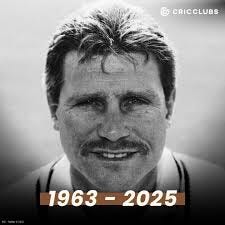
A man ahead of his time, a man gone too soon, a man who made my childhood infinitely better

Summer 1988, and the all-conquering West Indies side of Greenidge, Haynes, Richards, Marshall, Ambrose, and Walsh was in the process of dismantling England once again. Already 2-0 up in the five-match series, attention shifted to Leeds for the fourth test match. England were seeking their first win at home against the West Indies for 19 years, and had added fresh blood to the side. Worcestershire opener Tim Curtis and Hampshire top-order batter Robin Smith made their debuts, while Chris Cowdrey became the nation’s third captain of the series.
Viv Richards won the toss and put England in. Graham Gooch departed early on for just 9 runs, before the loss of Tim Curtis (12), David Gower (13), and Bill Athey (16) hastened the arrival of Smith to join his compatriot, Alan Lamb, at the crease with the score 80 for 4.
The two South African-born batters not only hung around to frustrate the West Indian attack, but they also began to score freely. Lamb added 64 from just 91 balls before tearing a calf muscle and being forced to retire hurt, while Smith rode a barrage of chin music from his county teammate, Marshall, to make 38 from the same number of balls before being caught behind off the bowling of Ambrose.
Smith, known affectionately as ‘Judge’ on account of his curly hair reminiscent of the judiciary, would go on to make 11 in the second innings, before making his first test-match half-century in the fifth and final test of the series at The Oval. Thus began a love affair between English cricket and one of the bravest and finest batters of the 80s and 90s.
Backyard Cricket
About 15 miles away from Robin Smith’s spiritual cricketing home, Northlands Road in Southampton, a seven-year-old lad was forced to endure chin music of his own from his elder brother. Beneath a sprawling magnolia tree that doubled up as first and second slip, I stood in front of a set of stumps. Steve, just turned 12, steamed in from the kitchen end and unleashed all sorts of lairy and intimidating stuff my way, varying his line and length probably more through luck than judgement.
He was the West Indies, I was the pathetically anaemic English batting line-up.
As tennis balls whumped into my midriff and forced me to duck and weave, I edged my way as best I could to a defendable total. I’d pretend to be Gooch, Curtis, a right-handed Gower, Lamb, and then Smith.
This series against the West Indies was the first I remember taking any notice of on television. These were the days in which the BBC broadcast ball-by-ball coverage, chopping and changing between Channels 1 and 2, while the soft, kindly Welsh lilt of Tony Lewis intermingled with the brusquer, Yorkshire tones of Ray Illingworth. I knew many of the players’ names. Gooch, Botham, Lamb, and Gower, and remembered the images from the previous winter’s tour, when captain Mike Gatting remonstrated with Pakistani umpire Shakoor Rana.
Robin Smith’s debut was the first time I remember actively sitting down to watch a test match. I knew a Hampshire player had been picked, and already admired Robin’s brother, opener Chris, from afar. A former test cricketer himself, Chris Smith was a doughty performer, amassing runs in huge numbers at the top of Hampshire’s order alongside another former test cricketer, Paul Terry.
Watching cricketers bat is a curious thing. Some are very easy on the eye. They bat with a gracefulness that borders on poetry as they get into line and defend, or shift their weight onto the front foot and coax the ball through the covers. Others are all nervous energy and fidgety at the crease before, during, and after the ball’s been delivered.
I always enjoyed watching Michael Atherton bat. His economy of movement and watchfulness in defence, awaiting the bad ball which he’d apologetically dismiss to the boundary, was wonderful to witness. Graham Thorpe was another. Left-handed and a batsman of real authority. Good either side of the wicket when pulling or cutting, his judgement of when to nudge and nurdle to keep the scoreboard moving, and when to accelerate was a rarity in the early to mid-1990s.
Robin Smith was top of the tree for me. His stance was beautiful. Knees slightly bent, shoulders hunched somewhat, everything in line as his bat waited horizontally at waist height during the bowler’s approach to the wicket. I loved that the handle on his Grey Nicholls bat was bright yellow. So much more interesting than the usual blues and whites I was used to seeing.
Then, once the ball was delivered, the way in which he moved to get into position to play a shot was something I couldn’t take my eye off. Whether he got forward to defend or drive, or glance anything that strayed onto his pads through the leg side, he looked in full control. He was better at dealing with the short-pitched stuff than most. He was a tremendous puller, keeping his eyes fixed on the ball as he got on top of it to guide it from shoulder-height behind square on the leg side.
Yet, it was anything short of a length just outside off stump that was Smith’s trademark. Rocking onto his back foot, knees bent, his bat would scythe through the air horizontally at chest height, and the ball would race through Point, invariably for four runs.
It was this stroke that I would spend hours on end trying to recreate in my back garden. I dressed the part. A sweatband around my head covered by a cap, a shin pad fastened to my forearm with elastic bands to act as an arm guard. A pair of old pads purchased from a school jumble sale, and a pair of gardening gloves to protect my precious fingers. I set up a set of stumps about 8 yards from the back of the house, and threw a ball against the wall, aiming for it to pitch outside off stump.
Again and again and again, I’d bend my knees, rock back, and try to cut the ball square of the wicket.
Again and again and again, I’d fail miserably. The ball might spin tamely to where a very close second slip might be standing, but it never ended up in the hedge or tomato patch where I was hoping it might.
I’d take the bat indoors with me when no one was looking, and shadow bat endlessly in front of the mirror in my parents’ room, careful not to smash the porcelain nick-nacks lining the windowsill and chest of drawers.
The best of his era
I enjoyed watching Smith bat across eight English summers. With success at a premium between 1988 and 1995, Smith was often a rare oasis of competence amidst a sea of rank mediocrity.
Between his debut and the 1992 tour to New Zealand, Smith scored 2,118 runs at 52.95. This record marked him out as one of the finest batsmen in the world at the time, while those around him were struggling to average 40.
His first Ashes series at home in 1989 saw him come to the fore as a household name. England lost the six-match series 4-0, yet Smith scored 553 runs at 61.44. This tally included his first two test centuries, a tremendous 143 at Old Trafford in the fourth test, followed by 101 at Trent Bridge in the fifth. He also scored 66, 96, and 77 not out in a series that saw him outscored only by Dean Jones (566) and Mark Taylor (839).
A year later, he averaged 180.50 at home to India, an effort overshadowed by Graham Gooch’s tremendous 333 and 123 at Lord’s in the first test. Smith helped himself to an unbeaten century in the first innings at Lord’s, before adding an undefeated 121 at Old Trafford in the second test. Scores of 61* and 57 contributed to his overall tally of 381 across six innings.
Smith struggled on his only Ashes tour in Australia in 1990/91, averaging a shade under 30 against the attack of Bruce Reid, Terry Alderman, Merv Hughes, and Craig McDermott, before returning to form against West Indies the following summer.
He was at his destructive best in the 2nd test at Lord’s, plundering an unbeaten 148 in a drawn match. After missing the 3rd test, he added a second century in the final test at The Oval with 109 before being trapped lbw by Marshall as England won to tie the series 2-2.
He was second in the run-scoring stakes for England to Graham Gooch, albeit in two fewer innings. His average of 83.20 against the fearsome quartet of Marshall, Ambrose, Walsh, and Patrick Patterson cemented Smith’s legacy as an expert against hostile pace bowling.
Struggles against Spin
As much as Smith is remembered for his bravery and ability to take on the fiercest, fastest bowling anyone could throw at him, he’s equally maligned for his record against spin.
His technique, honed in South Africa, saw Smith develop hard hands. This meant he was susceptible to spin, something that the Aussie duo Shane Warne and Tim May ruthlessly exposed during the 1993 Ashes. Warne accounted for Smith’s wicket four times, May three times, and even Mark Waugh’s part-time off-breaks trapped Smith leg before in the second innings at Trent Bridge.
Indeed, prior to this, all eight of Smith’s dismissals during the tours of India and Sri Lanka in the winter of 1993, all eight of Smith’s came against spin. Anil Kumble was responsible for four of his six dismissals in India, while Muttiah Muralitharan dismissed him - albeit for 127 - in Colombo.
Smith’s highest test score came in the fifth test at Antigua in 1994. Four years earlier, he was hit on the jaw by a searing Courtney Walsh bouncer at the same ground and was forced to retire hurt. Any lingering trauma was firmly dismissed, though, as he hammered his way to 175, an innings that lasted just shy of seven hours and included 26 fours and three sixes. It was an innings that Smith needed, with his place in the team under threat after an underwhelming tour to that point. However, sadly, it would prove to be his ninth and final test match century. His 84 in the first innings of the second test was his only other score above 24 on the tour.
Another underwhelming series at home against New Zealand in 1994 saw Smith dropped for the visit of his native South Africa later that summer, and the 3-1 defeat in the 1994/95 Ashes.
Smith played only nine more times for England. He played four out of five matches at home to the West Indies, missing the final test due to a broken jaw from an Ian Bishop bouncer, and retained his place for England’s first post-apartheid tour of his homeland, South Africa, the following summer.
Although he failed to add to his tally of test centuries, Smith passed 40 on nine occasions in his final 13 test match innings, with four half-centuries. However, that consistency wasn’t enough to stop the selectors from dropping him for the home series against India and Pakistan.
Robin’s test career spanned 62 matches. He scored 4236 runs at an average of 43.67, with 28 half-centuries and nine 3-figure innings. At the time of his banishment from the England team, he had the highest average of any active batter, and while the second half of his test career didn’t hit the high standards of the first half, it still bore comparison with his peers.
Indeed, his career average tops those of Graham Gooch, Ian Bell, Michael Vaughan, Alec Stewart, Nasser Hussain, Mike Gatting, and Michael Atherton, among many others. In addition, Smith was a fearsome ODI player. His fabulous unbeaten 167 from 163 balls against Australia in 1993 remained the highest innings by any English men’s player for 23 years.
Self-doubt, self-harm
Smith continued to play for Hampshire until 2003 before retiring. He moved to Australia to join his brother Chris in Perth. Mark Nicholas, the broadcaster and Smith’s captain at Hampshire, devotes a chapter in his excellent book, A Beautiful Game: My Love Affair With Cricket, to the Smith brothers.
In it, he talks at length about what made the duo such assets for Hampshire and, in Robin’s case, England. In particular, he mentions Robin’s crushing insecurity and self-doubt. Something, which anyone who watched him stand up to the likes of Marshall, Ambrose, Walsh, Allan Donald, Waqar and Wasim, and countless other genuinely fast bowlers of the era, would find hard to believe.
Yet, how often is that the case? Genius talent, wracked with self-doubt?
Nicholas opens the lid on Robin’s struggles with depression, anxiety, alcoholism, and suicidal thoughts. The intervention of Chris arguably saved his life, offering him work, a home, and support as Robin battled against the bottle, and began a new loving relationship following the breakdown of his marriage.
Robin sadly died on 1st December this year, aged 62. The cause of death remains unknown.
Only a week before, he’d been in the company of England’s Lions, spending time talking to them about his long and successful career, and, importantly, about mental health. He’d also taken the time to offer his services should any of them need a chat, support, or just a friendly ear. This is a mark of the man who, in all the tributes I’ve heard and read, speaks volumes about the kind of man Robin was.
When I was 11 or 12, Robin signed an autograph for me at Nicholas’ benefit. I still have it buried away somewhere in a shoe box. It’s rare that the death of someone in the public eye truly affects me. But Robin’s did. It shocked me enormously, but more than that, it really saddened me. Watching him brought me immeasurable pleasure as a child. Not only because of his ability, but because I spent countless hours in the back garden, trying to emulate the glory of his square cut.
He was, and remains, my favourite ever cricketing hero. It’ll take some player to dislodge him now.
So, thanks for the memories, Judge, rest well.